November 22, 2009
Long Term Impact on the Scientific World
Mendeleev's impact on the scientific world can only be described as monumental; one only has to look at a periodic table of the elements to see his immense contribution. During and after his lifetime, chemists, physicists, and biologists have added, rearranged, and examined his table, making it look completely different, but all that effort would've been impossible without the basis Mendeleev created. His work even earned him the name of the element Mendelevium as well as a university's name.

Short Term Impact on the Scientific World
Oddly, Mendeleev was one of a few historical figures whose impact at his time was somewhat similar to the long term impact. Essentially, around the time of his discoveries (late 19th c), Mendeleev was relatively well known, and once he published his book, major scientists all around the world knew the name Dmitri Mendeleev. His ideas were examined by Henry Moseley, William Raleigh, and other notable scientists of the time, allowing him to gain credibility and fame among scientists. Mendeleev won several awards for his table and book as well. On a non-chemical note, Mendeleev also appears to have had a part in the creation of a petroleum industry in Russia.
November 19, 2009
Major Ideas
Dmitri Mendeleev is most noted for creating the first periodic table of the elements. He was the first man to classify all of the known elements in a single table, creating an order of elements based on similar properties. His table grouped elements in order of increasing atomic mass, as opposed to increasing atomic number, the form used commonly today. Catching a pattern in the table he drew, he left spaces empty where he guessed, correctly, elements still to be discovered would be placed. An interesting note: because the noble gases (He, Ne, Ar, Kr, Xe, and Rn) are essentially non-reactive, none of them are present on Mendeleev's table. Mendeleev's biggest accomplishment was most likely that he created a solid basis for future chemists to build off of, which was lacking in his time.
November 18, 2009
Biography
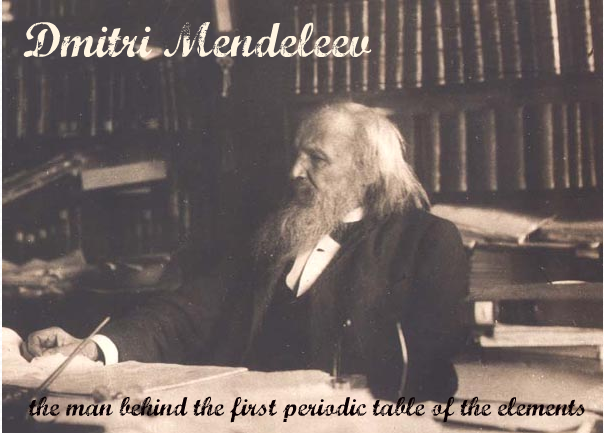
Dmitri Mendeleev was the scientist credited with the first periodic table.
On February 8, 1834, Dmitri Ivanovich Mendeleev was born to Ivan Pavlovich and Maria Korniliev in Tobolsk, Siberia. Dmitri’s family owned a glass factory, and it appears that his interest in science began watching the production of glass. Shortly after his father died, his mother took him took him to the St. Petersburg Pedagogical Institute in 1853. In 1856, he received his master’s degree in science. His scientific career progressed as he was employed by the Russian government to accumulate new technology (Russia was still behind technologically speaking), was appointed professor at universities, and awarded a doctorate of sciences.
Between 1869, Mendeleev published his work, Principles of Chemistry, in which he brought to attention new theories including a periodic law. He arranged the known elements of the time into a table, intelligently leaving out elements that he believed existed and were to be discovered. His table, or the periodic table, is the basis of the one chemists, students, and anyone interested in chemistry use today.
He continued to research and write during his lifetime, discovering what would be the element Germanium, and won numerous awards and a large amount of respect in his field. As for his romantic life, Mendeleev was married two times; first, Feozva Nikitchna Lascheva and second, Anna Ivanova Popova.
After his death on February 2, 1907, Mendeleev was still as venerated. Scientists in 1955 decided to name an element they discovered “mendelevium,” universities bear his name, and all chemists know of him.
Subscribe to:
Posts (Atom)
Mendeleev's Periodic Table

Mendeleev's original groupings by similar characteristics and atomic weight. http://commons.wikimedia.org/wiki/File:Mendeleev%27s_1869_periodic_table.png

